Can You Combine Autónomo and Employee Contributions for Unemployment in Spain?
Your Vida Laboral may show more than one year of Social Security contributions — and you may still have no right to unemployment benefits.
This is one of the most confusing situations for people who have worked in Spain both as an employee and as an autónomo.
You open your Vida Laboral report. You see months of activity, different employers, self-employed periods and more than 360 days registered with Social Security.
It looks like enough for unemployment.
But in many cases, it is not.
Quick summary
- Your Vida Laboral records your Social Security registration history.
- Overlapping periods are counted as one calendar day, not two.
- Employee unemployment and autónomo unemployment protection are separate systems.
- Time as an autónomo does not normally count towards employee paro.
- Time as an employee does not normally complete the requirement for cese de actividad.
- Pension rules are different: periods from different regimes can often be combined for retirement purposes.
Step 1 — What Your Vida Laboral Shows
Consider this real Vida Laboral example.
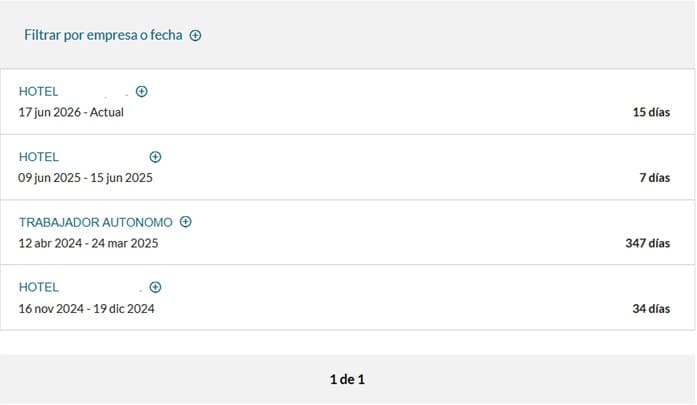
The detailed history shows several separate periods:
- 347 days as a trabajador autónomo
- 34 days as an employee
- 7 days under another employment contract
- 15 days under a later employment contract
At first glance, many people start adding the lines together.
347 + 34 + 7 + 15 = 403 days
That looks like more than enough time in the system.
But the summary page tells a more precise story.
Step 2 — Why 403 Days Become 369
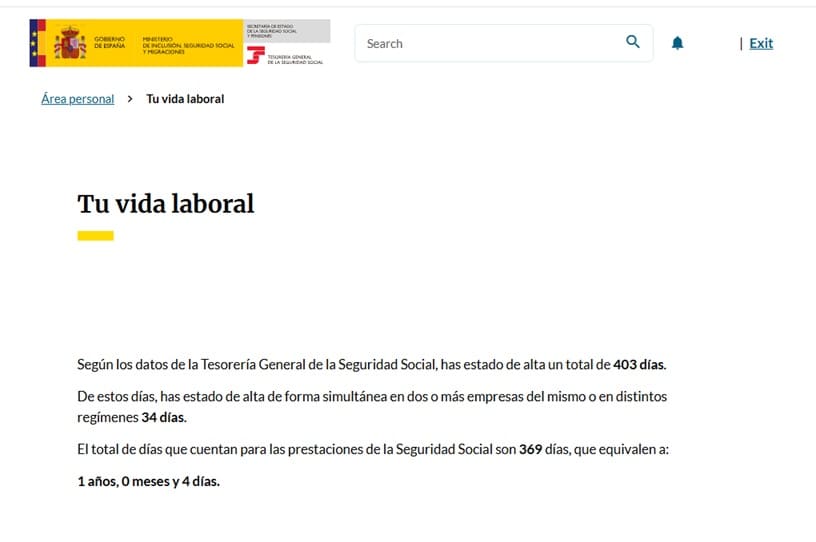
According to the summary:
- 403 days appear in the registration history.
- 34 days were spent simultaneously in two or more companies or Social Security regimes.
- 369 days count for Social Security benefits.
In other words, if you work as an employee and as an autónomo at the same time, that day does not become two days.
Spain counts calendar time, not the number of contribution records.
This situation is known as pluriactividad — working simultaneously as an employee and as an autónomo. If you're unfamiliar with the concept, see our guide on how pluriactividad works in Spain, including Social Security contributions and reduced RETA quotas.
403 total registered days − 34 overlapping days = 369 days
So far, this part makes sense: overlapping periods are not double-counted.
Up to this point, the calculation is straightforward. The real surprise comes next.
Step 3 — 369 Days Still May Not Be Enough for Unemployment
At this point, many people think:
I have 369 days in my Vida Laboral. That is more than one year. I should qualify for unemployment.
This is where the misunderstanding begins.
Your Vida Laboral combines your work history. Spain's unemployment system generally does not combine your contribution periods.
Two Different Unemployment Systems
Although both employees and autónomos contribute to Seguridad Social, they are protected by different unemployment systems.
| Employees | Autónomos |
|---|---|
| Prestación por desempleo, usually called paro | Cese de actividad |
| Usually managed by SEPE | Usually managed by your Mutua |
| Based on employee unemployment contributions | Based on autónomo cese de actividad contributions |
These are two completely separate unemployment insurance systems.
Time contributed as an autónomo does not normally count towards employee unemployment benefits, or paro.
Likewise, time contributed as an employee does not normally count towards the contribution period required for cese de actividad.
In other words, 347 days as an autónomo plus 15 days as an employee do not become 362 qualifying days for either unemployment benefit.
Each system applies its own contribution rules independently.
A Typical Example
Imagine someone who:
- worked 347 days as an autónomo;
- later accepted a 15-day employment contract;
- then became unemployed.
A natural reaction is: "I have more than 360 days in my Vida Laboral."
That may be true.
But those days belong to different protection schemes.
The employee contributions do not normally complete the minimum contribution period required for cese de actividad.
Likewise, the autónomo contributions do not normally count towards the employee unemployment benefit.
This distinction surprises many people because Vida Laboral displays everything in one place.
But Pensions Work Differently
This is probably why the Vida Laboral report feels confusing.
In the screenshots above, Social Security shows one combined working history. It lists periods as an employee and periods as an autónomo in the same report. It also calculates the total number of calendar days after removing overlapping periods.
That type of calculation is important for many Social Security purposes, especially long-term contribution history and retirement pensions.
For retirement pensions, Spain often allows contribution periods from different Social Security regimes to be combined, as long as the same calendar days are not counted twice.
This is why the summary can show a single total, such as 369 counted days, even though the person had activity in more than one regime.
The mistake is assuming that the same combined total automatically works for unemployment benefits.
It does not.
For unemployment, Spain does not simply ask whether your Vida Laboral shows more than 360 days in total. It asks which unemployment protection system those contributions belong to: employee paro or autónomo cese de actividad.
Why Is the System Designed This Way?
Spain historically created separate protection systems for employees and self-employed workers.
This separation didn't happen by accident. Spain's tax and Social Security systems evolved over many decades, with different rules introduced at different times for employees, self-employed workers and businesses. That's why today's obligations often feel like several systems working together rather than a single unified framework. Learn more in Why Spain's Tax System Looks the Way It Does.
Employees are covered by ordinary unemployment insurance.
Autónomos are covered by cese de actividad, which has its own rules, requirements and administration.
Both systems are part of Social Security, but they do not work like one single unemployment account.
That is why the same Vida Laboral can show more than one year of Social Security time while the person still does not qualify for a specific unemployment benefit.
Common Misconceptions
"My Vida Laboral shows more than one year."
That does not automatically mean you qualify for unemployment.
The type of contribution matters, not only the total number of calendar days.
"I paid Social Security every month."
That is true for both employees and autónomos, but not every Social Security contribution creates the same unemployment rights.
"I only need another few days."
Only if those days are in the same relevant system.
A short employment contract usually does not complete the missing days for cese de actividad, and a short autónomo period usually does not complete employee paro.
"Everything should be combined."
For pensions, often yes.
For unemployment, generally no.
Before Switching Between Employee and Autónomo
If you are planning to close your business and become an employee, or leave employment to become an autónomo, check how the change affects your unemployment protection.
Many people only discover the difference after losing one type of protection without qualifying for the other.
This can be especially important if you are close to the minimum contribution period, if your autónomo activity is ending with losses, or if you are accepting a very short employment contract.
Related Guides
- How to Register as an Autónomo in Spain
- Quarterly Tax Filing Checklist for Autónomos in Spain
- Can You Be an Autónomo and Full-Time Employee in Spain?
- Can You Invoice Without Being Autónomo in Spain?
- How Much Tax Will I Pay as an Autónomo in Spain?
Final Thoughts
Your Vida Laboral tells the story of your working life.
It records employers, registrations, autónomo periods and Social Security time.
But it does not, by itself, tell you which unemployment benefit you qualify for.
For pensions, contribution periods from different Social Security regimes often work together.
For unemployment, they generally do not.
Understanding that difference before changing your employment status can prevent a very expensive surprise.
Working as an autónomo in Spain?
Autonomo.help helps freelancers and remote professionals in Spain understand invoices, expenses, VAT, Modelo 130, Modelo 303 and quarterly tax obligations.
Start Now