Why Spanish Banks Freeze Accounts: What Foreigners and Autónomos Need to Know in 2026
A Spanish bank account can be frozen, restricted or even closed if the bank cannot verify your identity, residence status or source of funds.
For foreigners in Spain, this often starts with a simple request: upload a new passport, renew your TIE information, confirm your tax residency or explain where money in the account comes from.
Many customers assume these requests only happen once when opening the account. In reality, Spanish banks carry out periodic KYC reviews throughout the customer relationship, especially when identity documents expire or tax residency information needs to be updated. We explain why this happens in Why Does My Spanish Bank Keep Asking for My Tax Residency Every Year?.
If the request is ignored, the result can be serious. Transfers may stop working, cards may be blocked, incoming payments may be rejected, and the bank may eventually cancel the products linked to the account.
For autónomos, this can create an even bigger problem. A blocked account can cause Social Security contributions, tax payments and business direct debits to fail.
If you are new to self-employment in Spain, our complete guide to self employed in Spain explains how registration, taxes, VAT, Social Security, invoicing and business banking all work together.
Quick summary
- Spanish banks can restrict accounts when customer information is missing or outdated.
- In some cases, the bank can also cancel products and close the account.
- These checks are linked to anti-money laundering rules, especially Law 10/2010.
- Foreign residents may be asked for updated passports, TIE cards, proof of address or tax residency information.
- A frozen account can cause direct debit payments to fail.
- For autónomos, failed Social Security payments may create debt, surcharges and administrative problems.
Can a Spanish Bank Freeze or Even Close Your Account?
This is not just a theoretical possibility.
Below is a real notice from BBVA informing a customer that the bank intends to cancel banking products and immediately restrict account operations in order to comply with due diligence requirements under Spain's anti-money laundering legislation, specifically Law 10/2010.
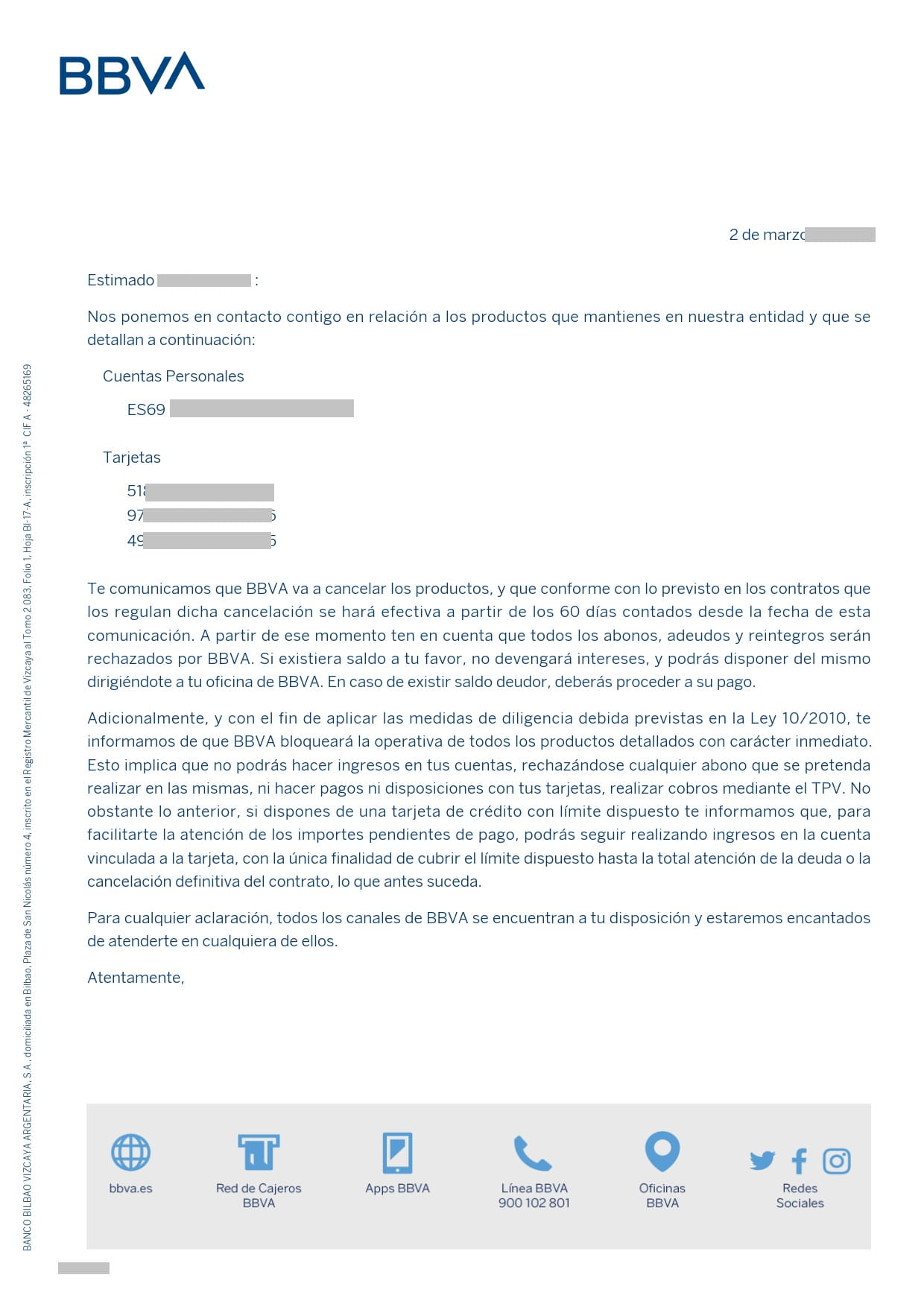
The notice specifically mentions that deposits, transfers, withdrawals, card payments and other banking operations may be rejected. It also informs the customer that the contractual relationship may be terminated after the notice period expires.
Why Do Spanish Banks Freeze Accounts?
Many people search for “Spanish bank account frozen” only after their card stops working or a transfer is rejected.
Common reasons for a frozen or restricted Spanish bank account include:
- Expired passport
- Expired TIE card or residence permit
- Outdated address information
- Tax residency verification
- Source of funds checks
- Unusual account activity
- International transfers requiring additional review
- Missing customer information
In many cases, the customer did nothing wrong. The problem is that the bank could not complete a required compliance review.
Many people are surprised by these checks, but they are part of a much broader evolution of Spain's administrative system. Modern tax reporting, banking compliance, VAT and Social Security obligations were introduced through different reforms over nearly two centuries. If you're curious how today's system developed, see Why Spain's Tax System Looks the Way It Does.
What Documents Can a Spanish Bank Request?
Depending on your situation, your Spanish bank may ask for:
- Passport
- TIE or residence permit
- NIE number confirmation
- Proof of address
- Tax residency declaration
- Employment contract
- Autónomo registration documents
- Proof of income
- Documents explaining the source of funds
Banks may also offer additional products such as life insurance, home insurance, health insurance or professional liability insurance during account reviews or when updating customer information. Learn more in our guide on why Spanish banks try to sell insurance to autónomos, expats and digital nomads.
For many autónomos, "proof of income" does not mean a traditional payslip. Banks may instead request tax returns, invoices, bank statements and other supporting documents. Learn more in our guide on the autónomo equivalent of a payslip in Spain.
If you are self-employed and not sure whether your registration is complete, see our guide on how to register as an autónomo in Spain.
Why Foreigners in Spain Are More Likely to Face Account Restrictions
Foreign residents often experience more document checks because their legal and tax status may change over time.
You may renew your TIE card, receive a new passport, become a Spanish tax resident, register as an autónomo or start receiving income from clients abroad.
Each of these changes can trigger questions from your bank, especially if your account is used for business income or international payments.
During these reviews, banks may also recommend additional products such as health insurance, life insurance or professional liability insurance. These products are not always mandatory. See our guide on why Spanish banks try to sell insurance.
If you invoice clients outside Spain, you may also want to read our guide on invoicing a client outside Spain as an autónomo.
Can a Frozen Bank Account Affect an Autónomo?
Yes. This is the part many new autónomos do not think about until it happens.
If your Spanish bank account is frozen, restricted or scheduled for closure, direct debit payments may fail. This can affect:
- Social Security contributions
- Quarterly tax payments
- VAT payments
- Income tax prepayments
- Supplier invoices
- Business subscriptions
For an autónomo, this can quickly become more than a banking problem. It can become a tax and Social Security problem.
If you file quarterly taxes yourself, see our guides on Modelo 130 and Modelo 303.
What Happens If Your Autónomo Social Security Payment Fails?
New autónomos in Spain may benefit from the reduced Social Security contribution known as the Cuota Reducida, previously known as the Tarifa Plana.
A common fear is that if one monthly payment fails, the autónomo automatically loses the reduced quota forever.
The situation is more nuanced. A single failed direct debit does not automatically mean that the reduced-rate program is lost forever. However, an unpaid Social Security contribution can still create serious problems.
Possible consequences include:
- Late payment surcharges
- Outstanding Social Security debt
- Loss of “al corriente de pago” status
- Difficulties accessing certain grants or subsidies
- Problems with extensions or related benefits
In other words, the danger is not simply the failed payment itself. The danger is leaving the debt unresolved.
What Is “Al Corriente de Pago” and Why Does It Matter?
“Al corriente de pago” means that you are up to date with your payment obligations.
Many benefits, reductions, grants and administrative procedures in Spain depend on this status. If you have unpaid Social Security debt, you may no longer meet the requirements for certain incentives.
This is why autónomos should check every month that their Social Security contribution has actually been collected.
How a Bank Restriction Can Turn Into an Autónomo Problem
The connection between banks and Social Security is simple: autónomo payments are often collected by direct debit.
If your bank account is blocked, restricted, scheduled for closure or has insufficient funds, the payment may fail.
What started as a missed document request from your bank can lead to unpaid Social Security contributions, surcharges and problems proving that you are up to date with your obligations.
A frozen bank account is only one possible consequence of unpaid tax obligations. If a tax debt enters Spain's enforcement stage, Hacienda may also use electronic collection procedures involving payment service providers. Learn more in our guide on Can Hacienda Seize Money from PayPal, Wise or Payoneer?.
How to Avoid a Frozen or Closed Bank Account in Spain
Most banking restrictions can be avoided with a few simple habits:
- Check messages in your banking app regularly
- Keep your passport and TIE up to date with your bank
- Update your address after moving
- Reply quickly to document requests
- Keep proof of income and source of funds documents ready
- Make sure your bank has your current phone number and email
- Do not ignore letters mentioning account cancellation
Related Guides
- How to Register as an Autónomo in Spain
- How to Invoice a Client Outside Spain as an Autónomo
- How to File Modelo 130 Yourself in Spain
- How to File Modelo 303 Yourself in Spain
- Can Hacienda See My Bizum Payments?
Final Thoughts
A frozen Spanish bank account is usually not a sign of fraud or wrongdoing. In many cases, it is the result of a missed document request or outdated customer information.
But the consequences can be serious. Your bank may not only restrict the account. It may also cancel products and close the relationship if the required verification cannot be completed.
For autónomos, the stakes are higher. A blocked or closed account can cause Social Security payments and tax payments to fail, creating debt, surcharges and unnecessary administrative problems.
Self-employed in Spain?
Autonomo.help helps self-employed professionals in Spain organize income, expenses, VAT information and quarterly tax calculations in one place.
Start Now