Why Does My Spanish Bank Keep Asking for My Tax Residency Every Year?
You already proved who you are.
You showed your passport.
Your NIE.
Your TIE.
Your proof of address.
You opened the bank account years ago.
So why is your Spanish bank asking for everything again?
And why are they warning that your account may be restricted if you do not respond?
If you are a foreign resident, digital nomad or autónomo living in Spain, this situation is very common.
Many customers receive regular requests asking them to confirm tax residency, upload a new TIE, provide their latest Renta, explain where their income comes from or complete another KYC form.
It may feel excessive. But in many cases, the request is legitimate.
Quick summary
- Spanish banks must periodically update customer information.
- This is part of Spain's anti-money laundering and KYC framework.
- Banks often ask customers to confirm tax residency every year.
- They may also request updated identity documents, proof of income, Renta or source-of-funds information.
- If you ignore repeated requests, your account may be restricted, frozen or closed.
Why Does This Happen?
Many people think identity verification happens only once: when the bank account is opened.
That is not how Spanish banking works.
Under Spain's anti-money laundering rules, customer identification is an ongoing obligation. Banks must keep the information they hold about customers accurate and up to date.
A customer who was tax resident in Spain last year may have moved abroad. A residence card may have expired. A freelancer may have become an employee. Someone who used to receive a salary may now receive payments from foreign clients.
From the bank's point of view, these changes matter.
Why Do They Keep Asking About Tax Residency?
Tax residency is one of the most common questions Spanish banks ask foreign customers.
This surprises many people because they see tax residency as a matter between them and Hacienda.
But banks also have reporting obligations.
Under international frameworks such as CRS, and in some cases FATCA, financial institutions need to understand where customers are tax resident and which tax identification number applies to them.
That is why a bank may periodically ask you to confirm:
- your country of tax residence;
- your Spanish NIF, NIE or foreign tax identification number;
- whether you are tax resident in more than one country;
- whether your personal or professional situation has changed.
Why Does My Bank Ask for My Renta or Tax Return?
This is one of the most uncomfortable requests.
Many customers ask: why does my bank want my Spanish income tax return?
Usually, the bank is not trying to recalculate your taxes. It is trying to understand two different compliance concepts:
- Source of funds: where the money entering your account comes from.
- Source of wealth: how you accumulated your overall financial position.
A recent tax return can help support that analysis, especially for autónomos, company owners, freelancers, investors and people with foreign income.
Real example: Openbank requesting additional KYC documents
The following email from Openbank illustrates how these reviews work in practice. As part of a customer knowledge (KYC) update, the bank rejected a previously uploaded employment activity document because it was incomplete and asked the customer to submit a new version.
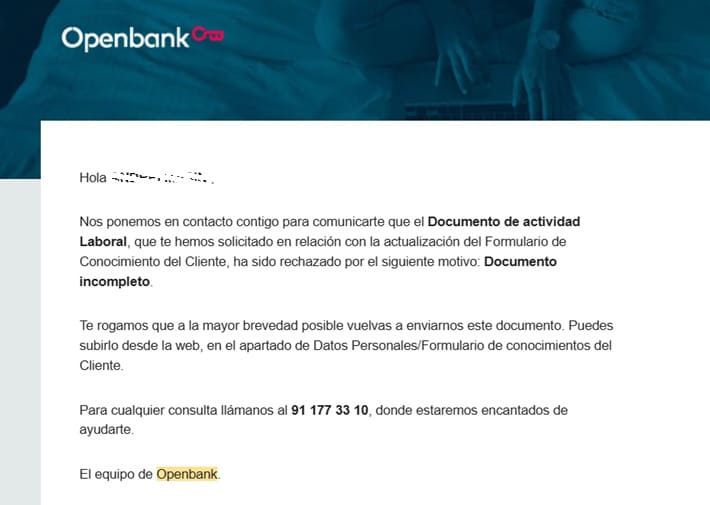
This is a typical compliance request rather than a tax investigation. Spanish banks may ask customers to update employment information, tax residency, identity documents or proof of income whenever existing information is incomplete, outdated or no longer reflects the customer's current situation.
If you are self-employed in Spain, your bank may also ask for evidence of your activity, such as autónomo registration, invoices or quarterly tax filings. If you are unsure how your income is normally documented as an autónomo, see our guide on the autónomo equivalent of a payslip in Spain.
Why Do They Ask for My TIE Again?
Foreign residents often receive requests when their TIE is close to expiry or has already expired.
The bank may ask you to upload:
- the new TIE card;
- a renewed passport;
- proof that the TIE renewal has been requested;
- a resguardo or appointment confirmation;
- the new card once it is issued.
This is not necessarily because the bank thinks you did something wrong. The bank simply cannot keep relying forever on expired identity or residence documents.
If you are confused about the difference between a NIE number and a TIE card, read our guide on NIE vs TIE in Spain.
Common Documents Spanish Banks May Request
| Document | Why the bank may ask |
|---|---|
| Passport | Identity verification |
| TIE or residence card | Confirmation that residence documentation is valid |
| TIE renewal receipt | Temporary proof while waiting for the new card |
| Tax residency declaration | CRS / FATCA reporting |
| Spanish income tax return | Source-of-funds and income verification |
| Employment contract | Current occupation and income |
| Autónomo registration | Business activity |
| Recent payslips or invoices | Evidence of recurring income |
Not every customer will be asked for every document. Banks apply a risk-based approach, which means requests can vary depending on the customer, account activity, nationality, tax residency, occupation and transaction profile.
Why Every Year?
Because KYC is not a one-time event.
It is an ongoing monitoring process.
Banks periodically review customer profiles and request updates when documents expire, information becomes outdated or the customer's activity no longer matches the profile the bank has on file.
Simple rule for foreigners in Spain
If your TIE, passport, address, tax residency or source of income changes, assume your bank may eventually ask for updated documents.
Do not wait until your card stops working or your transfers are blocked.
What Happens If You Ignore the Request?
Different banks follow different internal procedures. But a typical sequence may look like this:
- The bank sends an email, app notification or letter.
- You receive reminders with a deadline.
- Some services may become limited.
- Outgoing transfers may require review or stop working.
- Cards or online banking functionality may be restricted.
- The account may eventually be frozen or closed.
This is why annual KYC requests should not be ignored, even when they feel repetitive.
We explain the account restriction side in more detail in our guide on why Spanish banks freeze accounts for foreigners and autónomos.
Is This Only for Foreigners?
No.
Spanish citizens can also receive KYC and AML requests from their banks.
However, foreigners are often asked for more documents because the bank may also need to monitor:
- residence permit validity;
- passport expiry;
- international tax residency;
- foreign tax identification numbers;
- cross-border payments;
- changes between employee, autónomo and remote worker status.
Digital nomads and freelancers are especially likely to receive additional questions because their income may come from foreign companies, platforms or clients.
Is This the Same as Hacienda Checking My Taxes?
No.
A bank KYC request is not the same as a tax investigation.
The bank is not acting as your gestoría and it is not recalculating your IRPF or VAT. It is usually checking whether it understands who you are, where you are tax resident, what you do and where the money in the account comes from.
That said, banks and tax authorities operate in the same broader compliance environment. If you want to understand what Hacienda may see through different channels, read our guides on whether Hacienda can see your PayPal balance and whether Hacienda can see your Bizum payments.
Why Do Banks Mention Law 10/2010?
Many Spanish bank requests refer to Law 10/2010.
This is Spain's main law on the prevention of money laundering and terrorist financing.
In practical terms, banks use this legal framework to justify requests for identity verification, customer due diligence, transaction monitoring and updates to customer information.
This is why the same bank may ask for documents again even if you already provided them in a previous year.
Real-Life Example
A foreign resident living in Spain receives a notification from their bank requesting:
- confirmation of tax residency;
- a copy of the latest TIE;
- proof that the new TIE has been requested because the card has expired;
- the latest Spanish income tax return;
- updated information about professional activity.
The customer ignores the request.
Several weeks later, outgoing transfers stop working and the bank asks the customer to visit a branch or upload the missing documents before restoring full access.
This scenario is common enough that many foreigners in Spain only realize how serious KYC requests are after account functionality has already been restricted.
What Should You Do?
- Check that the request really comes from your bank.
- Do not upload documents through suspicious links.
- Use the official bank app, website or branch.
- Keep your TIE, passport and tax residency information updated.
- Save proof that your TIE renewal has been requested.
- Respond before the deadline when the request is legitimate.
The same caution applies to tax-related messages. Scammers often imitate official institutions and banks. If you receive a message claiming to be from Agencia Tributaria, see our guide on how to verify an AEAT SMS or tax notification.
Common Myths
| Myth | Reality |
|---|---|
| I already passed KYC when I opened the account. | KYC is ongoing, not a one-time event. |
| The bank asking for my Renta means Hacienda is auditing me. | Usually no. The bank may be checking source of funds. |
| Only foreigners receive these requests. | Spanish customers can also receive them, but foreigners may be asked for more documents. |
| If I ignore it, nothing serious will happen. | Ignoring repeated requests can lead to account restrictions. |
Related Guides
- Why Spanish Banks Freeze Accounts: What Foreigners and Autónomos Need to Know
- Can Hacienda Take Money From an Abandoned Bank Account?
- Why Is My Spanish Bank Trying to Sell Me Insurance?
- Can I Use Wise as an Autónomo in Spain?
- Can Hacienda Seize Money from PayPal, Wise or Payoneer?
- What Is the Autónomo Equivalent of a Payslip in Spain?
Frequently Asked Questions
Is it normal for a Spanish bank to ask for tax residency every year?
Yes. It is common for Spanish banks to periodically ask customers to confirm tax residency, especially when the customer is foreign, self-employed, has foreign income or has documents that expire.
Can my bank block my account if I do not respond?
Yes, it may restrict certain services if required information is missing. The exact process depends on the bank, the account and the customer profile.
Does this mean I did something wrong?
Not necessarily. Many requests are routine updates. The problem usually starts when the customer ignores the request or cannot provide documents the bank considers necessary.
Should I send documents by email?
Prefer the official bank app, secure website or branch. Be careful with links in emails or SMS messages, especially if they create urgency or use unfamiliar domains.
What if my new TIE is not ready yet?
The bank may accept proof that the renewal has been requested, but this depends on the bank. Once the new card is issued, you may still need to upload it.
Final Thoughts
If your Spanish bank asks you to confirm your tax residency every year, it does not automatically mean you are under investigation.
In most cases, the bank is complying with ongoing KYC and anti-money laundering obligations.
The easiest way to avoid unnecessary account restrictions is to keep your identity documents, tax residency information, contact details and source-of-income documents up to date.
Managing your autónomo taxes in Spain?
Autonomo.help helps self-employed professionals in Spain organize income, expenses, VAT information and quarterly tax obligations in one place.
Start Now