Can Autónomos Deduct Laptops, Phones and AI Tools? The Real Problem Is Proving It
Many autónomos in Spain assume that if an expense is needed for work, it should be deductible.
A laptop for remote work. A mobile phone for client calls. A headset for video meetings. A subscription to ChatGPT or another AI tool for documentation, research or technical work.
In theory, the logic seems simple. If the expense is connected to the professional activity, it may be deductible.
In practice, the difficult part is often not the deduction itself. The difficult part is proving it when Hacienda asks questions.
If you're wondering which expenses are usually easier to defend and which ones carry a higher practical risk during a tax review, see our Business Expense Risk Guide for Autónomos.
What Spanish Tax Rules Require
Autónomos in Spain may generally deduct expenses that are linked to their economic activity. For VAT purposes, those deductions are normally reported through Modelo 303.
But the practical question is not only whether a laptop, phone or software subscription can be deductible in principle.
The practical question is whether the autónomo can demonstrate that the expense is sufficiently connected to the business activity.
Why Technology Expenses Are Frequently Reviewed
Some expenses are easy to understand as business expenses: accounting services, professional insurance, invoicing software or tax filing support.
Technology purchases can be more complicated because they can also be used personally.
Common examples include:
- Laptops
- Mobile phones
- Tablets
- Headsets and microphones
- Internet and cloud services
- AI tools and software subscriptions
This does not mean these expenses are automatically invalid. It means that Hacienda may ask for evidence.
This is why document organization matters. As explained in our guide on what Hacienda may request after filing Modelo 303, a VAT return is not always the end of the process.
A Real Case: Remote Work Accepted, Equipment Rejected
A recent case reviewed by Autonomo.help illustrates the issue.
An autónomo working remotely for a U.S. company had issued invoices without Spanish VAT, applying the rules normally relevant to international B2B services.
The activity itself was documented. The client relationship was documented. The invoices issued to the U.S. company were reviewed.
The Tax Agency did not dispute that professional services were being provided.
However, several technology-related VAT deductions were questioned, including:
- A laptop
- Mobile phones
- A tablet
- A headset with microphone
These are ordinary tools for many remote professionals. But in this case, Hacienda was not convinced that the professional use had been sufficiently demonstrated.
The Unexpected Result
The result was striking.
Out of approximately €700 in VAT deductions under discussion, only around €23 was accepted. That accepted amount related to a professional consultation from a gestoría.
The deductions related to the laptop, phones, tablet and headset were challenged.
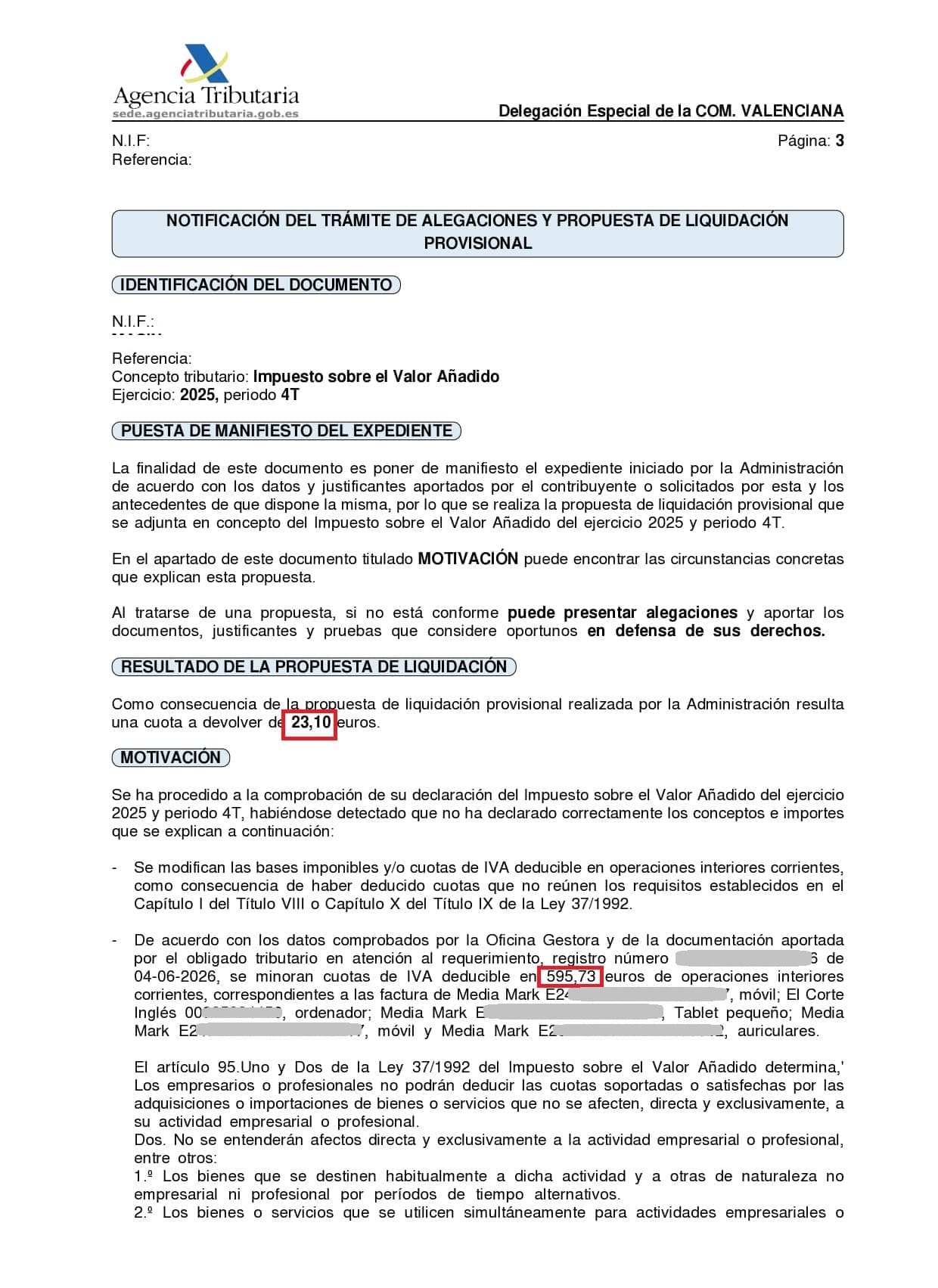
Proposed VAT adjustment issued by Agencia Tributaria. The professional activity was not the main issue; the dispute focused on whether the equipment deductions were sufficiently supported.
The contradiction at the heart of this case
Hacienda accepted that the taxpayer was providing remote services to a U.S. company.
The client relationship, invoices and professional activity were not the central issue.
Yet the Tax Agency questioned the deductibility of the laptop, phones, tablet and headset used to perform that remote work.
The dispute therefore became a question of evidence rather than a question of whether the activity existed.
Why This Matters for Remote Workers
Remote work often depends almost entirely on digital tools.
A professional working for a foreign client may need:
- A computer to access client systems
- A phone for authentication and communication
- A headset for calls and video meetings
- Cloud storage and collaboration tools
- Project management software
- AI tools for research, writing or technical support
At the same time, many of those same tools can also be used personally. That is why Hacienda may require additional proof.
The issue becomes especially important for people invoicing foreign clients. For more context on VAT and foreign clients, see our guide on how to invoice a client outside Spain as an autónomo.
Can an Autónomo Deduct a Laptop?
A laptop may be deductible if it is used for the professional activity and the taxpayer can demonstrate that connection.
For many autónomos, especially those working remotely, a computer is one of the most basic work tools.
But the case above shows that Hacienda may still ask for an explanation. The invoice alone may not always be enough.
Can an Autónomo Deduct a Phone?
Mobile phones are more sensitive because they are commonly used for both business and personal purposes.
A phone may be necessary for client calls, two-factor authentication, business messaging apps, banking verification or travel-related work.
However, if Hacienda reviews the deduction, the taxpayer may need to explain why the phone is linked to the activity.
Can an Autónomo Deduct a Headset or Microphone?
For remote professionals, a headset with microphone may be a normal work tool.
It can be used for client calls, video conferences, technical meetings, sales calls or support sessions.
Nevertheless, as the real case above shows, even ordinary remote work tools may be questioned if the professional connection is not considered sufficiently documented.
Can ChatGPT and AI Tools Be Deducted?
AI tools are becoming part of daily professional work for many autónomos.
Examples include ChatGPT, Claude, GitHub Copilot, Perplexity, Notion AI and similar services.
These tools may support:
- Research
- Documentation
- Technical writing
- Translation
- Software development
- Client communication
- Project analysis
A professional subscription may be easier to justify than a physical device, but the same principle applies: the taxpayer should be able to explain how the tool is used in the business.
What Evidence Can Help?
Depending on the situation, useful supporting evidence may include:
- Supplier invoices for the equipment or subscription
- Contracts or client agreements
- Invoices issued to clients
- Proof that the work is performed remotely
- NDA or confidentiality agreements
- Business email accounts
- Project management tools such as Jira, Miro or Trello
- Communication platforms such as Slack or Google Meet
- Written explanations of how each item is used
The goal is not to create unnecessary paperwork. The goal is to be able to explain the business logic of the expense if it is ever reviewed.
This is also why a good quarterly tax filing checklist should include not only invoices, but also supporting documents for larger or more sensitive deductions.
What Happened Next in the Real Case?
The taxpayer did not accept the proposed adjustment immediately.
Formal objections, known as alegaciones, were submitted to Hacienda.
The response explained the professional activity, the remote nature of the work, the client relationship, the use of corporate systems, and the role of the equipment in providing services.
Hacienda later issued its final decision after reviewing the taxpayer's objections and supporting documentation.
The outcome may surprise many remote professionals.
Read the follow-up article: Hacienda Accepted the Remote Work, Rejected the Tools: The Unanswered Question for Autónomos and Digital Nomads
The Real Lesson
Many autónomos ask:
- Can I deduct a laptop?
- Can I deduct a phone?
- Can I deduct ChatGPT?
A better question may be:
If Hacienda asks about this expense later, what evidence will be available to support it?
The real problem is not always whether an expense can be deductible in theory.
The real problem is proving why it was necessary for the professional activity.
The final outcome of this real case is discussed in: Hacienda Accepted the Remote Work, Rejected the Tools
Related Guides
- Hacienda Requested Documents for a VAT Return (Modelo 303)
- How to File Modelo 303 Yourself in Spain
- How to Invoice a Client Outside Spain as an Autónomo
- Quarterly Tax Filing Checklist for Autónomos in Spain
- Do You Really Need a Gestoría for 1–2 Invoices Per Month?
Preparing Modelo 130 or Modelo 303?
Autonomo.help helps self-employed professionals organize income, expenses, VAT information, and quarterly tax calculations while keeping full control of their documents.
Start Now